
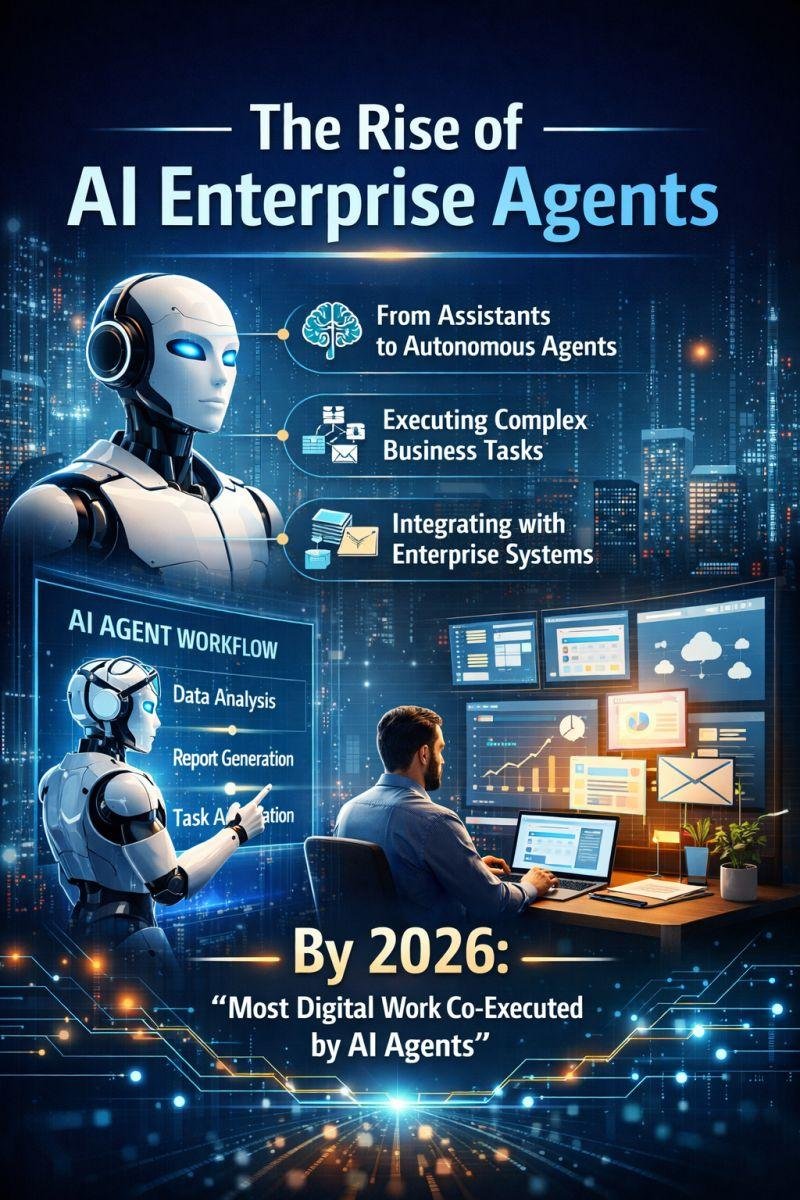
The Autonomous Enterprise: How AI Agents Will Redesign Business by 2030
The next transformation in business will not simply be about using more artificial intelligence.
It will be about redesigning how the business operates.
For decades, organizations digitized processes, automated repetitive tasks and connected employees through enterprise software. Generative AI then changed how people interact with information. The next stage is agentic AI, where AI agents can reason, plan, use tools and execute multi-step tasks with increasing autonomy.
This is creating the autonomous enterprise.
By 2030, organizations are likely to look very different from today's enterprises. AI agents will increasingly work across departments, coordinate workflows, interact with business applications and support decision-making at machine speed.
The question is no longer whether businesses will use AI.
The strategic question is:
How will businesses operate when AI agents become part of the workforce?
The Quick Answer: What Is an Autonomous Enterprise?
An autonomous enterprise is an organization where AI agents, enterprise data, applications and intelligent workflows work together to execute business processes with limited human intervention.
The concept goes beyond traditional automation.
Automation follows predefined rules.
An AI agent can interpret a goal, evaluate context, select tools, perform multiple steps and adapt its actions within defined policies.
Google Cloud describes the agentic enterprise as one that redesigns operations so AI agents and human experts can collaborate, scale and continuously learn together.
The evolution looks like this:
Manual Business → Digital Business → Automated Business → AI-Assisted Business → Agentic Enterprise → Autonomous Enterprise
The final stage does not mean a business without humans.
It means a business where humans define objectives and guardrails while AI systems increasingly execute operational work.
Why 2030 Could Be a Major Turning Point
The shift toward autonomous operations is already accelerating.
Gartner predicts that more than one in ten enterprises will be AI-first by 2030, with AI becoming a core consideration across business decisions, workflows and investments.
Gartner also forecasts that cross-functional multi-agent systems could execute 35% of enterprise workflows with minimal human approvals by 2030, compared with 3% in 2025.
Deloitte's 2026 research provides another indication of the scale of change: 74% of surveyed leaders expect nearly half of their business processes to be redesigned or rebuilt around AI agents within four years.
These projections do not mean every business will become fully autonomous by 2030.
They indicate something more important:
AI agents are moving from isolated productivity tools toward enterprise operating infrastructure.
From Applications to AI-Orchestrated Work
Traditional enterprise software requires employees to move between applications.
A typical process may involve email, CRM, ERP, spreadsheets, databases, dashboards and approval systems.
The employee becomes the integration layer.
Agentic AI changes this model.
An AI agent can potentially connect to multiple systems, retrieve information, reason about a business objective and execute approved actions.
The workflow becomes:
Business Objective → Context → AI Reasoning → Planning → Tool Use → Validation → Outcome
This is the foundation of agentic workflows.
Instead of asking employees to complete every step, organizations can delegate defined outcomes to AI agents.
Gartner's research indicates that agentic AI could put significant pressure on traditional enterprise software models because agents can complete tasks across multiple applications without requiring users to interact with every individual interface.
The application does not necessarily disappear.
But the human interaction with the application may change dramatically.
The Rise of the AI Workforce
One of the most important developments in the autonomous enterprise will be the emergence of an AI workforce.
Organizations will increasingly deploy specialized AI agents for specific business functions.
For example:
- Sales agents can research prospects and qualify opportunities.
- Finance agents can reconcile transactions and analyse financial data.
- HR agents can support employee services.
- Procurement agents can evaluate suppliers.
- Cybersecurity agents can investigate threats.
- Software engineering agents can write and test code.
- Customer-service agents can resolve routine cases.
- Supply-chain agents can monitor inventory and demand.
These agents can operate individually or as multi-agent systems, where several specialized agents coordinate to complete a larger business process.
IBM describes an agentic enterprise as one where AI agents are integrated across business functions and can plan and execute multi-step tasks alongside human employees.
This creates a new concept:
Digital workers working alongside human workers.
How AI Agents Will Redesign Business Functions
The impact will extend across virtually every industry.
Customer Experience
AI agents will increasingly provide personalized support, resolve routine requests and coordinate customer journeys across systems.
Finance
AI-powered workflows can automate reconciliation, reporting, invoice processing, forecasting and financial analysis.
Human Resources
AI agents can assist with recruitment administration, onboarding, employee queries and workforce analytics.
Manufacturing
Autonomous systems can connect production planning, predictive maintenance, quality management and supply-chain operations.
Healthcare
AI agents can support scheduling, documentation, administrative processes, inventory and operational coordination while keeping clinical decisions under appropriate human oversight.
Cybersecurity
AI agents can analyse security telemetry, investigate alerts, enrich incidents with threat intelligence and support automated response.
Software Development
AI coding agents can participate in requirements analysis, coding, testing, security review and documentation.
The common theme is business-process transformation.
Organizations will not simply add AI to existing workflows.
They will increasingly redesign workflows around AI.
The Autonomous Enterprise Architecture
Building an autonomous enterprise requires more than deploying an AI chatbot.
A practical autonomous enterprise architecture needs several layers.
Data Foundation
AI agents require trusted and accessible information.
Organizations will need governed data platforms, knowledge graphs, vector databases and reusable business context.
McKinsey highlights governed, reusable data as a critical foundation for scaling agentic AI across the enterprise.
AI and Model Layer
Foundation models, specialized models, retrieval systems and reasoning capabilities provide the intelligence layer.
Agent Layer
Specialized AI agents perform defined business functions.
Orchestration Layer
AI orchestration coordinates agents, tools, applications and workflows.
Integration Layer
APIs and enterprise platforms connect AI agents to operational systems.
Security and Governance Layer
Identity, authorization, data protection, policy enforcement, monitoring and auditability control autonomous activity.
Human Oversight Layer
People remain responsible for high-impact decisions, exceptions and strategic direction.
This architecture creates the foundation for AI-native enterprise transformation.
The Biggest Challenge: Autonomy Without Control
Greater autonomy also creates greater risk.
An AI agent connected to a document repository is one thing.
An AI agent capable of changing financial records, accessing sensitive customer information or modifying production infrastructure is something entirely different.
This is why AI governance and AI security will become central to the autonomous enterprise.
Organizations will need:
- AI agent identity
- Least-privilege access
- Dynamic authorization
- Data security
- Tool governance
- Agent monitoring
- Audit trails
- Human approval
- AI red teaming
- Runtime security
- Incident response
- Emergency controls
Gartner warns that applying the same governance model to every AI agent can create failures because agents operate at different autonomy levels and across different trust boundaries.
The principle should therefore be:
The greater the autonomy, the stronger the governance.
The New Enterprise Operating Model
The autonomous enterprise will also change organizational design.
Traditional organizations are structured mainly around departments.
AI-native organizations will increasingly organize work around outcomes and intelligent workflows.
A customer journey could involve sales, service, finance and logistics agents.
A product-development workflow could involve research, engineering, testing, security and documentation agents.
Humans increasingly become:
Strategists + Decision Makers + AI Orchestrators + AI Governors
This does not eliminate human expertise.
It changes where human expertise is applied.
Employees can spend less time moving information between systems and more time solving complex problems, managing relationships, creating new products and making strategic decisions.
Deloitte's 2026 research found that 75% of surveyed leaders believe collaboration between humans and AI agents creates more value than AI-agent automation alone.
The future is therefore not simply AI versus humans.
It is increasingly humans plus AI agents.
What Will Happen to Enterprise Software?
The rise of autonomous AI may fundamentally change the software market.
Today, employees purchase and use applications because they need interfaces for specific tasks.
In an agentic enterprise, employees may increasingly communicate with an AI orchestration layer that accesses multiple applications on their behalf.
This could change the economics of SaaS.
Gartner estimates that up to $234 billion of enterprise application software spending could be exposed to agentic arbitrage by 2030, representing roughly 20% of enterprise SaaS spending.
The implication is significant.
The competitive advantage may shift from:
More Features → Better User Experience → More Seats
toward:
Better Intelligence → Better Orchestration → Better Business Outcomes
Enterprise software could increasingly become infrastructure behind AI-driven workflows.
Common Failure Modes
Organizations moving toward autonomous operations should avoid several mistakes.
Automating broken processes: AI will not automatically fix inefficient workflows.
Ignoring data quality: Poor data produces unreliable decisions.
Giving agents excessive permissions: Autonomous systems need least-privilege access.
Deploying without governance: AI agents need clear ownership and policies.
Measuring activity instead of outcomes: More agents do not automatically mean more value.
Removing humans too quickly: High-impact and ambiguous decisions still require appropriate human oversight.
Deloitte reports that only 5% of surveyed organizations consider their business processes highly prepared for AI agents, showing the significant gap between AI ambition and organizational readiness.
A Practical Roadmap to 2030
Organizations do not need to become fully autonomous immediately.
A practical roadmap can follow five stages.
2026 — AI Readiness
Build data, security, identity and governance foundations.
2027 — AI-Assisted Operations
Deploy copilots and AI assistants across high-value knowledge workflows.
2028 — Agentic Workflows
Introduce specialized AI agents into controlled business processes.
2029 — Multi-Agent Orchestration
Connect agents across departments and enterprise applications.
2030 — Autonomous Operations
Allow trusted AI agents to execute defined business outcomes within policy and governance boundaries.
The timeline will differ by organization.
The objective should not be maximum autonomy.
It should be appropriate autonomy with measurable business value.
India and the Autonomous Enterprise
India is becoming an important market for enterprise AI transformation.
SAP reported in 2026 that 85% of Indian organizations surveyed expect agentic AI to transform business operations, while organizations are moving from experimentation toward value-driven implementation.
SAP India also emphasizes that autonomous operations require standardized processes, connected data and strong governance rather than simply deploying more AI tools.
For Indian enterprises, this creates a significant opportunity across IT services, healthcare, banking, manufacturing, retail and other sectors.
But the organizations that benefit most will need to combine:
AI innovation + data readiness + cybersecurity + governance + process redesign.
Conclusion
The autonomous enterprise is becoming one of the defining business models of the next decade.
By 2030, AI agents may no longer be viewed as experimental tools. They could become an integral part of how enterprises manage customers, employees, technology, finance, supply chains and operations.
The biggest transformation will not be the number of AI models an organization owns.
It will be the number of business outcomes that intelligent systems can safely execute.
The enterprise of 2030 will therefore look very different from the enterprise of today.
Humans will continue to provide strategy, creativity, judgment and accountability.
AI agents will increasingly provide speed, scale, coordination and autonomous execution.
The winners of this transformation will not simply deploy more AI.
They will redesign the organization around it.
The future enterprise will not merely use AI to run the business.
AI will become part of how the business runs.
By Dr. Akhilesh Kumar
References
- Gartner — Gartner Identifies the Top Trends for Data and Analytics, 2026.
- Gartner — Enterprise Architecture 2030: Navigating Agentic AI Scenarios, 2026.
- Gartner — Gartner Says $234 Billion in Enterprise Application Software Spend Is at Risk from Agentic AI, 2026.
- Gartner — Gartner Says Applying Uniform Governance Across AI Agents Will Lead to Enterprise AI Agent Failure, 2026.
- Gartner — Forecast Analysis: Cross-Functional AI Agents and Assistants, Worldwide, 2026.
- Google Cloud — Building the Agentic Enterprise, 2026.
- Deloitte — AI Agents Are Only the Beginning: The Path to Agentic Transformation, 2026.
- McKinsey & Company — Reimagining Tech Infrastructure for and with Agentic AI, 2026.
- SAP India — From Digital Core to AI Agents: How Indian Enterprises Are Advancing Towards Autonomous Operations, 2026.
- IBM — What Is an Agentic Enterprise?, 2026.
Comments (0)
No comments yet. Be the first to share your thoughts!
Leave a Comment