Shadow AI: The Hidden Cybersecurity Risk Inside Every Enterprise
Artificial intelligence is entering enterprises faster than most security and governance teams can track.
Employees are using AI assistants to write emails, analyze documents, summarize meetings, generate code, prepare presentations and conduct research. Developers are connecting AI coding tools to repositories. Business teams are experimenting with specialized AI applications. Employees are installing desktop AI agents and browser extensions. Autonomous agents are beginning to perform tasks without continuous human intervention.
Much of this activity never passes through the organization's formal IT, security or governance processes.
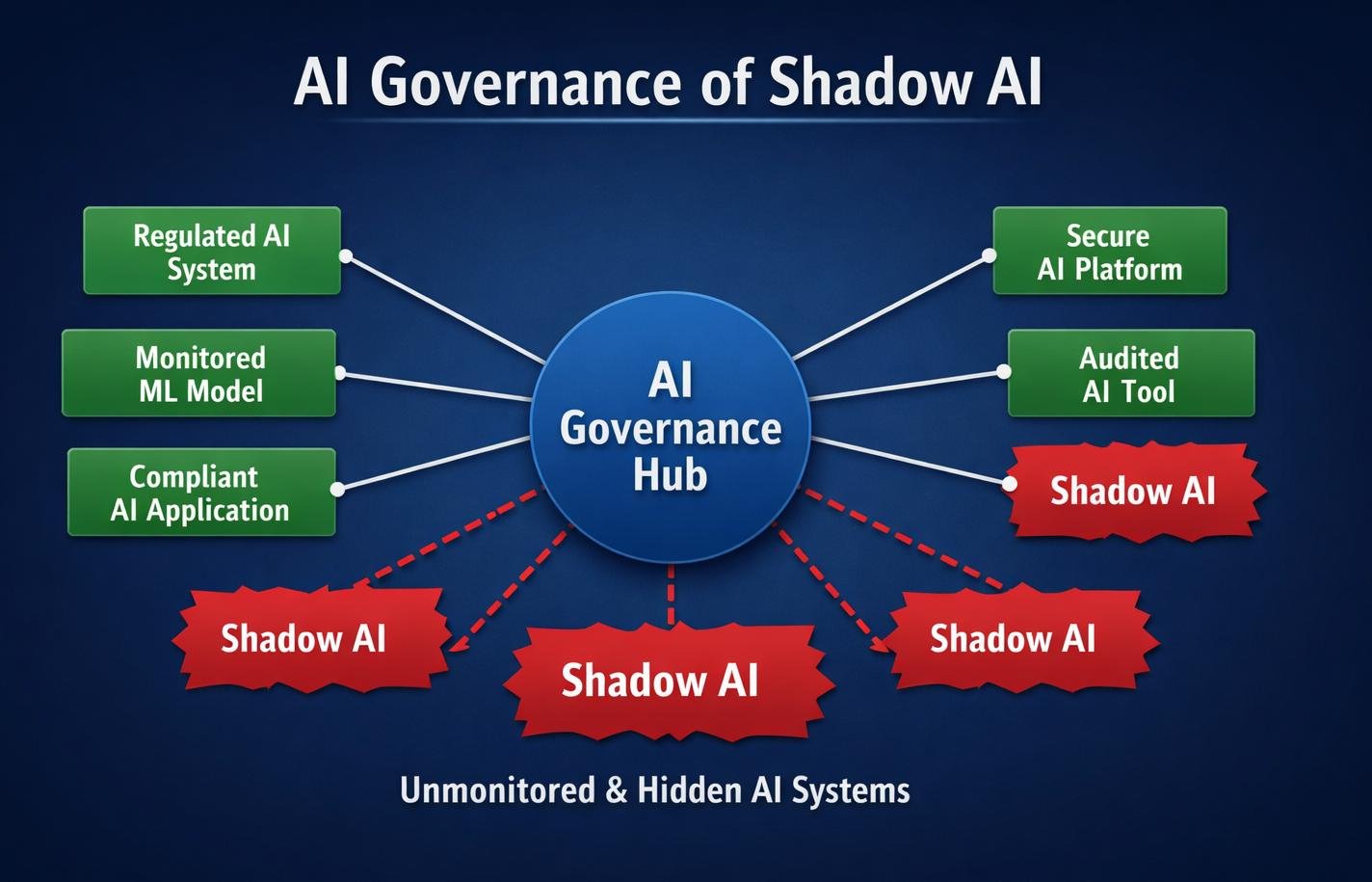
This is Shadow AI.
Shadow AI is becoming the AI-era equivalent of shadow IT, but with a potentially much larger security impact.
A traditional unsanctioned application might access a limited amount of business information. An AI system can potentially ingest documents, summarize confidential material, process source code, access APIs, interact with enterprise applications and retain sensitive context.
The problem is therefore not simply that employees are using AI.
The real problem is that organizations may not know which AI is being used, what data it can access, where that data goes, what permissions it has, and what actions it can perform.
Microsoft's current enterprise guidance defines Shadow AI around unmanaged AI applications and agents operating outside organizational governance, with risks including data leakage, compliance violations, security vulnerabilities and lack of auditability.
For security leaders, Shadow AI is becoming one of the most important blind spots in the modern enterprise.
1. What Is Shadow AI?
Shadow AI refers to AI tools, models, applications or autonomous agents used within an organization without appropriate IT visibility, security assessment, ownership or governance.
It can take several forms.
Employee - driven Shadow AI
Employees independently use public AI services for work.
Examples include:
- Public generative AI chatbots
- AI writing assistants
- AI presentation tools
- AI transcription services
- AI image generators
- Browser-based AI extensions
Developer Shadow AI
Developers introduce AI into software development without formal security review.
Examples include:
- AI coding assistants
- Unapproved model APIs
- Local open-source models
- AI-powered development agents
- Unapproved code-generation services
Agentic Shadow AI
This is potentially the most dangerous category.
Employees or teams deploy autonomous agents that can:
- Read files
- Send messages
- Access applications
- Call APIs
- Execute code
- Modify records
- Browse websites
- Invoke enterprise tools
These agents may never enter the organization's official AI inventory.
Embedded Shadow AI
AI functionality can also appear inside SaaS applications, productivity platforms and third-party services.
An organization may formally approve the application without fully understanding the AI capabilities embedded within it.
The result is an AI ecosystem that grows faster than enterprise visibility.
2. Why Shadow AI Is Different From Shadow IT
Shadow IT is not new.
Employees have always adopted unsanctioned applications when official systems were too slow, restrictive or difficult to use.
AI changes the equation because AI is simultaneously:
An application + an interface + a data processor + a reasoning system + potentially an autonomous actor.
A conventional application might store a document.
An AI application can:
- Read the document.
- Interpret its contents.
- Combine it with other information.
- Generate conclusions.
- Send those conclusions elsewhere.
- Trigger an action through another system.
This creates a much larger trust boundary.
Consider an employee who uploads an internal strategy document to an unapproved AI application.
The immediate event may appear harmless.
But the organization may not know:
- Where the document is processed.
- Whether the provider retains the data.
- Whether the data is used for service improvement.
- Which geographic region processes it.
- Who can access it.
- How long it remains available.
- Whether the content can be retrieved later.
- Whether the employee has violated contractual or regulatory requirements.
Shadow AI therefore turns AI usage itself into a security event.
3. The Four Major Risks of Shadow AI
Shadow AI creates several interconnected risks.
1. Data Leakage
This is the most obvious concern.
Employees may submit:
- Customer information
- Financial records
- Healthcare information
- Source code
- Contracts
- Intellectual property
- Credentials
- Internal reports
- Product roadmaps
- Security information
into systems that have not been approved for such data.
Traditional DLP systems were not designed around the semantic complexity of AI conversations.
The data may be hidden inside a prompt, uploaded file, generated summary or AI-generated response.
OWASP's 2026 GenAI data-security guidance emphasizes that AI security must address the entire data lifecycle, including training data, fine-tuning data, prompts and outputs.
2. Compliance Exposure
Unapproved AI usage can create problems involving:
- Privacy
- Data residency
- Data retention
- Intellectual property
- Sector-specific regulation
- Third-party risk
- Records management
- Auditability
The problem becomes particularly serious when employees process regulated information through services that have not undergone organizational assessment.
3. Excessive Privilege
Agentic Shadow AI introduces another dimension.
An employee may install an AI agent that requests access to:
- Calendar
- Cloud storage
- Code repositories
- CRM
- Collaboration platforms
- Databases
The agent may have legitimate productivity benefits.
But if its permissions exceed its business requirements, a compromised or manipulated agent becomes a new attack path.
NIST's current work on AI-agent identity and authorization explicitly highlights the security implications of giving software agents access to diverse data, tools and applications.
4. Lack of Accountability
If an AI application has no registered owner, security teams may not know:
- Who approved it.
- Who is responsible for it.
- What data it processes.
- Which model it uses.
- Which vendor operates it.
- What security controls apply.
- What happens when something goes wrong.
That makes incident response significantly harder.
4. Shadow AI Creates an Invisible Enterprise AI Estate
The traditional enterprise AI inventory often looks like this:
Approved Models → Approved Applications → Approved Agents
But the real environment increasingly looks like:
Approved AI + Developer AI + SaaS AI + Employee AI + Shadow Agents + Embedded AI
The difference between those two pictures is the AI visibility gap.
IBM reported in 2026 that 91% of surveyed executives did not fully understand their organizations' dependencies across AI vendors, models and infrastructure.
This is more than a governance problem.
It is a security problem.
Security teams cannot effectively protect an AI environment if they only know about the systems that were formally approved.
The unknown portion of the AI estate may contain some of the organization's highest-risk systems.
5. Shadow AI and the Rise of Autonomous Agents
The Shadow AI problem becomes substantially more serious when AI gains the ability to act.
A chatbot typically responds.
An agent can execute.
Imagine an employee installs an autonomous research agent.
The agent can:
- Read company documents
- Search the internet
- Access email
- Download files
- Create reports
- Send messages
Now introduce an indirect prompt injection hidden inside a webpage or document.
The agent reads the malicious content.
The content instructs the agent to perform an unauthorized action.
If the agent has excessive permissions, the attack may move from AI manipulation to enterprise compromise.
NIST's 2026 red-teaming research found successful hijacking attacks against every frontier model tested in a large competition involving more than 250,000 attack attempts.
The important lesson is not that AI agents are inherently insecure.
It is that unmanaged AI agents represent an unmanaged security boundary.
6. Why Blocking All Shadow AI Is the Wrong Strategy
A common response is:
Block every unauthorized AI application.
That may appear secure.
It is rarely sustainable.
Employees adopt Shadow AI because they have a legitimate need.
If the organization's approved tools are slow, restrictive or incapable of solving the problem, users will continue searching for alternatives.
The better strategy is:
Discover → Assess → Classify → Govern → Enable
rather than simply:
Discover → Block
Organizations should distinguish between:
Low-risk AI
General productivity tools handling non-sensitive information.
Medium-risk AI
AI systems processing internal information.
High-risk AI
AI systems processing regulated data, sensitive intellectual property or business-critical information.
Critical AI
AI systems capable of making consequential decisions or executing privileged actions.
Risk-based governance allows organizations to control dangerous usage without unnecessarily suppressing productive innovation.
7. The Shadow AI Discovery Layer
The first step is visibility.
Organizations need a mechanism capable of discovering AI usage across:
- Endpoints
- Browsers
- SaaS applications
- Network traffic
- API gateways
- Cloud environments
- Developer environments
- Identity systems
- Code repositories
- Agent platforms
Discovery should answer:
What AI exists?
Who is using it?
How frequently?
What data is being sent?
What systems does it access?
Is it approved?
Who owns it?
Microsoft's current Shadow AI capabilities illustrate this direction by combining detection of unmanaged AI agents with information about users, devices, network activity and policy enforcement.
The objective is not surveillance for its own sake.
It is to establish an accurate AI asset inventory.
8. AI Discovery Must Evolve Into AI Governance
Discovery alone is insufficient.
After identifying Shadow AI, organizations should classify it.
A practical governance model can use six dimensions:
| Dimension | Key Question |
|---|---|
| Identity | Who uses or owns it? |
| Data | What information does it process? |
| Model | Which model powers it? |
| Permissions | What systems can it access? |
| Behavior | What actions does it perform? |
| Risk | What is the potential business impact? |
This creates an AI Governance Graph.
For example:
Employee → Shadow Agent → Foundation Model → MCP Server → CRM → Customer Data
The security team can then understand the complete relationship rather than viewing each component independently.
This is where Shadow AI governance begins to connect with AI-SPM.
9. Data Controls Must Follow the AI User
Traditional DLP often focuses on files and communication channels.
AI requires a broader model.
Security controls should inspect:
Prompt + Attachment + Retrieved Context + Tool Input + Model Output + Tool Output
This creates an AI-aware DLP layer.
For example, if an employee attempts to upload a confidential document to an unsanctioned AI service, the security system should be able to:
- Identify the AI destination.
- Identify the sensitivity of the document.
- Evaluate organizational policy.
- Block or allow the transfer.
- Record the event.
- Alert security if required.
Microsoft's current Shadow AI protection guidance follows a similar staged model: discover AI applications, block unsanctioned services where appropriate, prevent sensitive data from reaching AI applications, and govern and audit AI interactions.
10. Building a Shadow AI Security Architecture
A mature enterprise architecture should contain several layers.
Layer 1 — Discovery
Identify AI applications, agents, APIs and AI-enabled services.
Layer 2 — Identity
Associate AI activity with users, devices, service identities and agents.
Layer 3 — Data Classification
Determine whether information is:
- Public
- Internal
- Confidential
- Restricted
- Regulated
Layer 4 — AI Risk Assessment
Evaluate:
- Vendor
- Model
- Data
- Permissions
- Location
- Security controls
- Business criticality
Layer 5 — Policy Enforcement
Apply policies based on risk.
Layer 6 — Runtime Monitoring
Monitor actual AI usage rather than relying only on declared configuration.
Layer 7 — Response
Automatically:
- Block
- Restrict
- Revoke access
- Quarantine data
- Disable an agent
- Alert security
- Create an investigation
This architecture transforms Shadow AI from an unknown problem into a manageable security domain.
11. Shadow AI Requires a New Employee Security Model
Technology alone will not solve the problem.
Employees need clear guidance.
Security teams should establish:
Approved AI Catalog
Provide users with approved AI tools for common business needs.
Data Handling Rules
Clearly explain what information can and cannot be entered into AI systems.
AI Security Training
Teach employees about:
- Prompt injection
- Data leakage
- Deepfakes
- AI-generated phishing
- Shadow AI
- Malicious AI applications
- Agent permissions
Simple Approval Process
If employees need a new AI service, approval should be fast.
A process that takes three months encourages Shadow AI.
A process that takes hours or days encourages governance.
The objective should be:
Make the secure path the easiest path.
12. The CTO and CISO Dashboard for Shadow AI
Technology leaders need measurable visibility.
A Shadow AI dashboard should include:
AI Discovery Coverage
Percentage of enterprise AI usage discovered.
Sanctioned vs Unsanctioned AI
Ratio of approved to unapproved AI applications and agents.
Sensitive Data Exposure
Number of AI interactions involving confidential information.
High-Risk Agents
Number of unmanaged agents with privileged access.
AI Ownership
Percentage of discovered AI assets with accountable owners.
Remediation Time
Average time from Shadow AI discovery to risk resolution.
Policy Violations
Number and severity of AI policy violations.
AI Attack Surface
Number of externally connected AI applications, agents and tools.
These metrics transform Shadow AI from an abstract governance concern into an executive security KPI.
13. From Shadow AI to Governed AI
The ultimate objective should not be eliminating AI experimentation.
It should be converting unmanaged innovation into governed innovation.
The transformation can follow this path:
Shadow AI → Discovered AI → Assessed AI → Governed AI → Trusted AI
This requires collaboration between:
- CIO
- CTO
- CISO
- CIO/CDO data leadership
- Legal
- Compliance
- Procurement
- HR
- Software engineering
- Business units
AI governance cannot remain the responsibility of a single committee.
AI has become part of the enterprise operating environment.
Therefore, its governance must become part of enterprise architecture.
14. The Future: Shadow AI Becomes a Continuous Security Problem
Shadow AI will not disappear.
The number of AI applications, models, agents and embedded capabilities will continue to grow.
New AI tools can appear faster than traditional procurement and security review processes can evaluate them.
NIST has already identified post-deployment AI monitoring as an important challenge because deployed AI systems can behave differently under changing inputs and environments, while monitoring practices and standards remain immature.
This means organizations will increasingly require continuous AI discovery.
The future enterprise AI security architecture will likely combine:
AI-SPM + DSPM + IAM + DLP + AI Observability + AI Red Teaming + AI Governance + SOC
into a unified security ecosystem.
Shadow AI discovery will become one of the first sensors in that ecosystem.
Conclusion: You Cannot Secure the AI You Cannot See
The greatest Shadow AI risk is not that employees use artificial intelligence.
The greatest risk is that the organization does not know where artificial intelligence is being used.
An unapproved AI application can become a data-exfiltration channel.
An unmanaged AI agent can become a privileged attack surface.
An embedded AI capability can introduce a new third-party dependency.
An innocent productivity experiment can evolve into a compliance incident.
And a tool nobody knows about cannot be effectively monitored, tested or secured.
The answer is not to stop AI adoption.
The answer is to build visibility, accountability and control into AI adoption.
Organizations should discover their AI estate continuously, classify risk intelligently, protect sensitive data, enforce least privilege, monitor runtime behaviour, and provide employees with secure alternatives.
The strategic shift is simple:
Shadow AI should not be treated merely as unauthorized technology. It should be treated as an unknown part of the enterprise attack surface.
The enterprises that win the AI race will not be those that eliminate experimentation.
They will be those that make secure AI adoption easier than insecure AI adoption.
Because in the age of autonomous systems, the most dangerous AI in an organization may not be the AI security teams know about.
It may be the AI they never knew existed.
#ShadowAI #AISecurity #Cybersecurity #ArtificialIntelligence #EnterpriseAI #AIGovernance #AIDataSecurity #DataLeakage #AIAgents #AIPrivacy #CISO #CTO #ZeroTrust #CyberResilience #RiskManagement #AICompliance #FutureOfCybersecurity
Author:
Dr. Akhilesh Kumar
References
- National Institute of Standards and Technology (NIST), AI Research – Security and Resilience, 2026.
- NIST, AI Risk Management Framework, including Generative AI and emerging AI security profiles.
- NIST, Challenges to the Monitoring of Deployed AI Systems, 2026.
- NIST, Accelerating the Adoption of Software and Artificial Intelligence Agent Identity and Authorization, 2026.
- NIST CAISI, Insights into AI Agent Security from a Large-Scale Red-Teaming Competition, 2026.
- OWASP GenAI Security Project, GenAI Data Security Risks & Mitigations 2026.
- OWASP GenAI Security Project, AI and Agentic Security Solutions Landscape, 2026.
- Microsoft, Shadow AI in Microsoft 365 Admin Center, 2026.
- Microsoft, Prevent Data Leak to Shadow AI, 2026.
- IBM, From Hidden AI to Governed AI: Closing the Visibility Gap with AI Asset Discovery, 2026.
Comments (0)
No comments yet. Be the first to share your thoughts!
Leave a Comment