Confidential AI: How Confidential Computing Is Redefining Enterprise AI Security
Introduction: The Missing Layer in Enterprise AI Security
Enterprise AI has entered a new phase.
Organizations are no longer experimenting only with public chatbots and general-purpose AI assistants. They are connecting artificial intelligence to highly sensitive enterprise information:
- Customer records
- Financial information
- Healthcare data
- Intellectual property
- Source code
- Legal documents
- Security telemetry
- Strategic business information
- Proprietary model weights
At the same time, AI agents are beginning to access this information autonomously, call enterprise tools and execute multi-step workflows.
This creates a fundamental security challenge.
Traditional cybersecurity has focused heavily on protecting data at rest and data in transit.
But AI introduces another critical state:
Data in use.
An AI model cannot reason over encrypted information in its normal execution environment. At some point, the data must become available to the computing infrastructure processing it.
That creates a security gap.
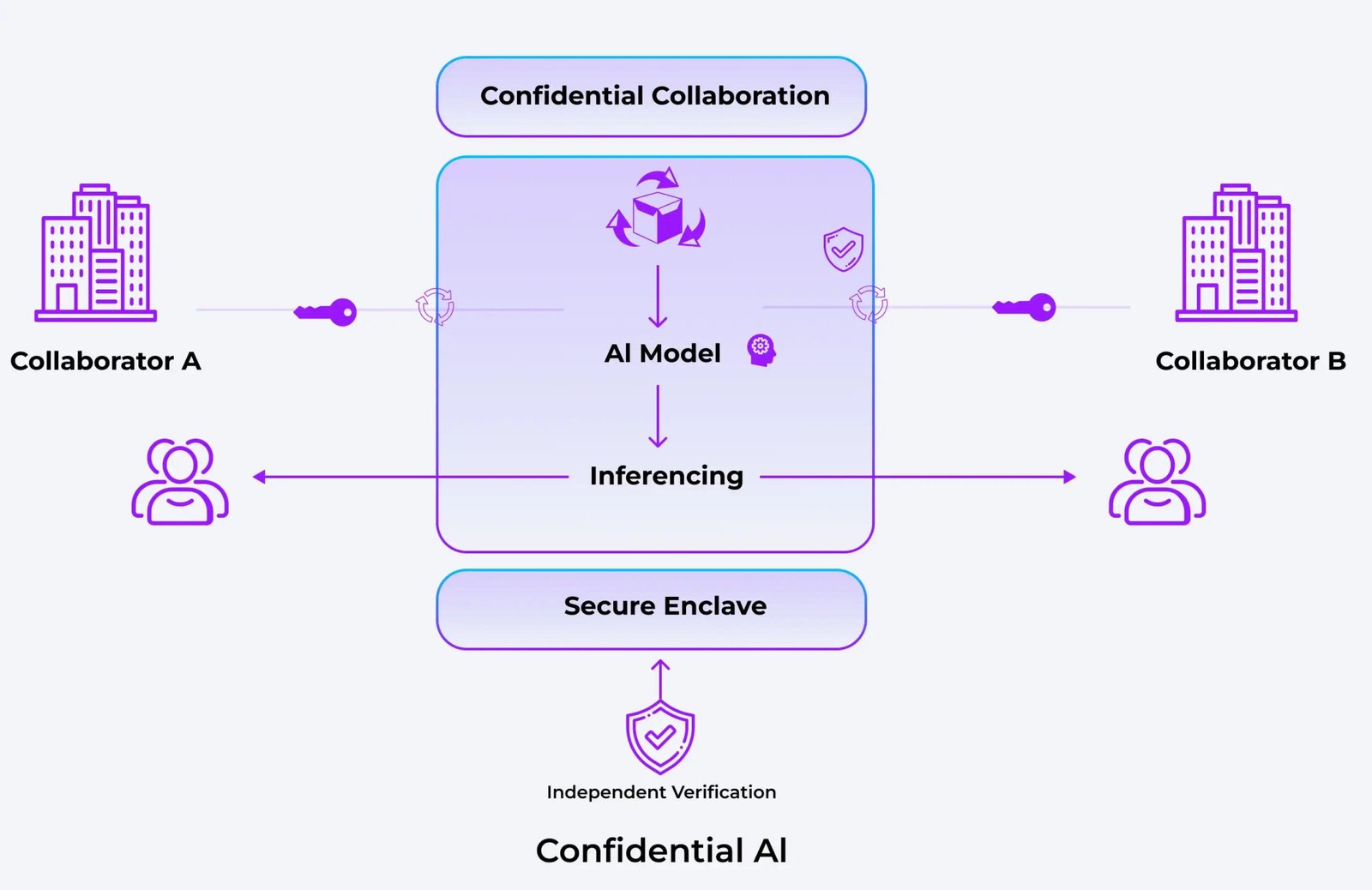
Confidential Computing is designed to close that gap by protecting sensitive data while it is being processed inside hardware-backed Trusted Execution Environments (TEEs).
NIST's 2026 work describes confidential computing as an approach for protecting data while it is actively being processed and specifically explores architectures for protecting AI workloads, including sensitive datasets and model intellectual property.
This is the foundation of Confidential AI.
From Secure Data to Confidential Data Processing
The traditional security model can be simplified into three states:
Data at Rest
Protected using encryption in databases, storage systems and backups.
Data in Transit
Protected using encrypted network protocols such as TLS.
Data in Use
Historically, data must generally be decrypted in memory while applications process it.
That third category is where Confidential Computing becomes important.
A simplified model is:
Encrypted Data → Trusted Execution Environment → AI Processing → Protected Output
The objective is to reduce exposure of sensitive information to:
- Host operating systems
- Hypervisors
- Infrastructure administrators
- Unauthorized processes
- Certain classes of cloud-provider access
- Malware operating outside the protected execution environment
Confidential AI extends this principle specifically to AI workloads.
Microsoft describes Confidential AI as hardware-based technologies that can provide cryptographically verifiable protection for data and models throughout AI processing, including confidential training and confidential inference.
Why AI Makes Data-in-Use Security More Important
Traditional applications generally process relatively predictable datasets.
AI workloads are different.
A single AI inference request may combine:
User prompt + Enterprise documents + Database information + Retrieval results + Model weights + Tool outputs + Agent memory
The model processes all of these elements together.
An autonomous AI agent can make this even more complex.
For example:
Employee → AI Agent → Enterprise Search → HR Database → LLM → External API
The agent may retrieve sensitive information, combine it with other data and generate a response.
The security question is no longer simply:
"Is the database encrypted?"
It becomes:
"What protects the information while the AI is actively processing it?"
That is where confidential AI becomes strategically important.
Confidential AI and Trusted Execution Environments
At the heart of confidential AI is the Trusted Execution Environment.
A TEE provides an isolated execution environment designed to protect code and data from unauthorized access by software outside the protected environment.
A simplified architecture looks like:
Application
↓
AI Runtime
↓
Trusted Execution Environment
↓
Protected CPU / GPU
↓
Hardware Root of Trust
The security model moves beyond software-only controls.
Instead of trusting every layer of the infrastructure stack, the organization can establish a hardware-backed trust boundary.
This is particularly valuable in cloud environments where customers may not control:
- Physical servers
- Hypervisors
- Host operating systems
- Infrastructure management layers
Confidential Computing is designed to reduce the amount of infrastructure that must be trusted directly.
1. Confidential Inference: Protecting AI Prompts and Responses
One of the most important applications is confidential inference.
Consider an enterprise using an external AI service.
The organization sends:
"Analyze this confidential acquisition document and identify financial risks."
The prompt may contain extremely sensitive information.
Traditional encryption protects the network connection.
But the AI service still needs access to the plaintext information during inference.
Confidential inference introduces hardware-backed protections around the execution environment.
Microsoft describes confidential inference as a mechanism for protecting both model IP and inference requests and responses from unauthorized parties involved in model serving and infrastructure operations.
This can be particularly important for:
- Banking
- Healthcare
- Government
- Defense
- Legal services
- Pharmaceutical research
- Intellectual property
- Corporate strategy
The objective is not simply private networking.
It is privacy during computation.
2. Protecting Proprietary AI Models
Enterprise AI security is not only about protecting data.
The model itself can be valuable intellectual property.
Organizations may invest enormous resources in:
- Model development
- Fine-tuning
- Proprietary datasets
- Training pipelines
- Specialized weights
- Domain-specific reasoning
- Reinforcement learning
If model weights are exposed, attackers may attempt:
- Model theft
- Reverse engineering
- Unauthorized replication
- Model extraction
- Intellectual-property theft
Confidential computing can protect model weights while they are being used.
NIST's 2026 confidential-computing draft specifically explores protecting both AI models and the sensitive data processed by those models through hardware-enforced isolation and controlled decryption.
This creates an important principle:
Confidential AI protects both what the model knows and what the model processes.
3. Confidential Training
Inference is only one part of the AI lifecycle.
Training and fine-tuning can involve even more sensitive information.
Consider a pharmaceutical organization training a model using proprietary research data.
Or several financial institutions collaborating on fraud detection.
Or healthcare organizations developing models from sensitive clinical datasets.
The challenge is obvious:
How can organizations use sensitive data for AI training without exposing the underlying information unnecessarily?
Confidential computing can provide hardware-backed protection for training workloads.
Microsoft highlights confidential training as a major Confidential AI use case and notes that confidential computing can also be combined with federated learning and privacy-enhancing techniques.
This opens opportunities for collaborative AI where organizations can share computational capabilities without simply placing all raw information into a common trust domain.
4. Confidential AI for Regulated Industries
The strongest business case for Confidential AI is likely to emerge in highly regulated industries.
Financial Services
Banks and financial institutions process:
- Customer financial records
- Transaction data
- Credit information
- Fraud intelligence
- Investment strategies
Confidential AI can help protect this information while enabling advanced analytics and AI inference.
Healthcare
Healthcare AI increasingly depends on:
- Electronic health records
- Medical images
- Genomic information
- Clinical notes
- Patient histories
Protecting this information during computation is critical.
Pharmaceuticals
AI systems can process:
- Drug discovery data
- Molecular information
- Clinical research
- Proprietary compounds
- Intellectual property
Confidential execution can strengthen protection around these workloads.
Government
Government systems frequently contain highly restricted information.
Confidential AI can provide an additional layer of hardware-backed protection for sensitive AI workloads.
Legal Services
Legal AI may process:
- Litigation documents
- Contracts
- Privileged communications
- M&A information
- Corporate investigations
Confidential inference can become an important component of trusted legal AI infrastructure.
5. Confidential AI and Cloud Security
Some organizations remain cautious about putting sensitive AI workloads in public cloud environments.
Their concern is straightforward:
"If the infrastructure is operated by someone else, how can we trust the environment processing our data?"
Confidential Computing changes the trust model.
The objective is not to blindly trust the cloud operator.
Instead, the workload can be executed inside a protected environment whose configuration can be verified through attestation.
This creates a new security model:
Trust the verified workload—not simply the infrastructure provider.
Google Cloud's current Confidential AI architecture, for example, combines confidential computing with attestation and protected AI infrastructure, including confidential GPU environments.
That is an important evolution in cloud security.
6. Remote Attestation: Proving Where AI Is Running
Confidential computing becomes significantly more powerful when combined with remote attestation.
Attestation allows a relying party to obtain evidence about the environment in which a workload is executing.
Conceptually:
AI Workload → Hardware Measurement → Attestation Evidence → Policy Verification → Data Release
The organization can establish policies such as:
Release sensitive data only if the approved AI workload is running inside an approved confidential environment.
This changes the security model from:
"We believe the environment is secure."
to:
"We have cryptographic evidence about the environment before releasing sensitive information."
MITRE's 2026 work on continuous remote attestation extends this concept across hardware, operating systems, containers, runtime environments, AI workloads and attested communications.
For enterprise AI, this is particularly significant.
7. Confidential AI for AI Agents
The rise of AI agents makes Confidential Computing even more relevant.
A conventional AI application may process one request.
An autonomous agent may continuously:
- Retrieve data
- Access databases
- Call APIs
- Invoke tools
- Communicate with other agents
- Store intermediate information
- Execute workflows
That means sensitive data may exist within the agent's execution environment for longer periods.
A compromised agent could potentially expose:
- Credentials
- API keys
- Retrieved documents
- Personal information
- Business data
- Agent memory
Confidential execution can establish a stronger boundary around the agent itself.
The goal becomes:
Confidential Agent Execution.
The agent's:
- Model
- Credentials
- Memory
- Prompts
- Retrieved information
- Intermediate state
can potentially be protected within hardware-backed environments.
The Confidential Computing Consortium has highlighted this emerging relationship between agentic AI and confidential computing, particularly because autonomous agents operate continuously across sensitive infrastructure.
8. Confidential AI Is Not the Same as Privacy
This distinction is important.
Confidential Computing provides strong protection for data and code during execution.
It does not automatically solve every AI privacy problem.
Organizations still need:
- Data minimization
- Access control
- Encryption
- Secure identity
- Privacy engineering
- Output filtering
- Data-loss prevention
- Model security
- Prompt-injection protection
- AI governance
Confidential Computing is therefore not a replacement for cybersecurity.
It is another security layer.
A mature AI security architecture should look more like:
Identity
Encryption
Access Control
AI Security
Confidential Computing
Runtime Monitoring
Governance
The strongest protection comes from combining these controls.
9. Confidential AI and the GPU Security Challenge
Modern AI is increasingly GPU-intensive.
Large language models, multimodal systems and agentic AI depend heavily on accelerated computing.
That creates an important question:
Can the confidential computing boundary extend beyond the CPU to the GPU?
The industry is increasingly moving in this direction.
NVIDIA describes its confidential-computing architecture as protecting sensitive AI data and model weights during inference and fine-tuning, with confidential capabilities extending into accelerated AI infrastructure.
This matters because protecting only the CPU environment may leave important parts of the AI execution pipeline outside the strongest trust boundary.
The long-term objective is an end-to-end confidential AI stack:
Application → CPU → GPU → Memory → Network → Storage
with verifiable trust across the entire execution chain.
10. Confidential AI and Zero Trust
There is a natural connection between Confidential Computing and Zero Trust.
Zero Trust says:
Never implicitly trust; continuously verify.
Confidential Computing adds:
Protect the workload even when parts of the underlying infrastructure are outside the trust boundary.
Together, they create a stronger architecture.
For example:
User Identity
↓
Agent Identity
↓
Policy Engine
↓
Attested AI Workload
↓
Confidential Execution
↓
Controlled Data Access
This means access to sensitive information depends not only on who is requesting it but also on where and how the computation is occurring.
That is a powerful evolution of Zero Trust for AI.
11. A Confidential AI Architecture for the Enterprise
Organizations building Confidential AI should consider six architectural layers.
Layer 1 — Identity
Establish strong user, workload and agent identities.
Layer 2 — Policy
Define exactly which AI workloads can access sensitive information.
Layer 3 — Attestation
Verify the execution environment before releasing protected data.
Layer 4 — Confidential Execution
Run AI workloads inside hardware-backed TEEs.
Layer 5 — Protected Communication
Secure prompts, responses, model interfaces and service-to-service communication.
Layer 6 — Continuous Monitoring
Monitor workload integrity, access patterns and security events.
This creates a trust chain:
Identity → Policy → Attestation → Confidential Execution → Secure Communication → Continuous Verification
12. A Practical Confidential AI Adoption Roadmap
Enterprises do not need to migrate every AI workload into confidential infrastructure immediately.
A risk-based roadmap is more practical.
Phase 1 — Identify Sensitive AI Workloads
Classify AI applications according to:
- Data sensitivity
- Model sensitivity
- Regulatory exposure
- Business impact
Phase 2 — Define the Trust Boundary
Identify which infrastructure components must be trusted and which should be isolated.
Phase 3 — Select Confidential Infrastructure
Evaluate available CPU, GPU, cloud and on-premises confidential-computing capabilities.
Phase 4 — Implement Attestation
Require cryptographic verification before releasing sensitive information.
Phase 5 — Protect Inference
Start with high-value inference workloads containing sensitive prompts or proprietary models.
Phase 6 — Expand to Training and Agents
Extend confidential execution to fine-tuning, training and autonomous AI workloads.
Phase 7 — Continuous Verification
Monitor workload integrity and continuously validate the trust chain.
This approach allows organizations to build Confidential AI incrementally rather than treating it as a complete infrastructure replacement.
13. The Business Value of Confidential AI
Confidential AI should not be viewed solely as a cybersecurity investment.
It can become a business enabler.
Without strong confidentiality guarantees, organizations may avoid using AI with their most valuable data.
With stronger technical protections, new use cases become possible.
For example:
Banks can collaborate on fraud detection.
Healthcare organizations can develop privacy-sensitive AI.
Pharmaceutical companies can protect research data while using advanced models.
Enterprises can use cloud AI for confidential workloads.
Organizations can protect proprietary models while outsourcing infrastructure.
In other words:
Confidential AI can convert security constraints into an innovation capability.
That may ultimately become its greatest strategic value.
The Emerging Confidential AI Stack
The enterprise AI security architecture of the future is likely to contain several complementary layers:
AI Security
Protect models, prompts, tools and agents.
Identity Security
Authenticate users, agents and workloads.
Data Security
Control access, classification and movement.
Confidential Computing
Protect data and models during execution.
Attestation
Verify the integrity of the execution environment.
Runtime Security
Monitor behaviour continuously.
AI Governance
Manage risk, accountability and compliance.
No single technology provides complete protection.
The future belongs to architectures that combine them.
Conclusion: Trust the Computation, Not Just the Cloud
The next generation of AI will process some of the most sensitive information ever placed into computing systems.
That creates a fundamental challenge.
Encryption at rest protects stored information.
Encryption in transit protects information moving across networks.
But AI needs to use information.
Confidential Computing addresses this critical gap by protecting sensitive data and model assets during computation through hardware-backed trusted execution environments and verifiable security mechanisms. NIST's current work specifically identifies confidential computing as an important approach for protecting AI workloads and sensitive data in cloud environments.
The strategic implication is significant.
Enterprise AI security will increasingly move from:
Protect the data.
to:
Protect the computation.
And eventually:
Prove that the computation itself is trustworthy.
Confidential AI provides an important foundation for that transition.
As AI agents become more autonomous, cloud infrastructure becomes more distributed, and enterprise datasets become more valuable, organizations will need stronger guarantees than policies and permissions alone can provide.
The future AI architecture will therefore combine:
Identity + Encryption + Zero Trust + Confidential Computing + Attestation + Runtime Security + Governance.
The organizations that master this combination will be able to use AI with information they previously considered too sensitive to expose to external or shared computing environments.
The future of secure AI is not simply private data.
It is verifiable computation over protected data.
That is the promise of Confidential AI.
#ConfidentialAI #ConfidentialComputing #AISecurity #CyberSecurity #AIPrivacy #PrivateAI #SecureAI #AIDataSecurity #TrustedExecutionEnvironment #TEE #EnterpriseAI #CloudSecurity #AIInfrastructure #AIAgents #ZeroTrust #CyberResilience #AITrust #CISO #CTO #ArtificialIntelligence
By Dr. Akhilesh Kumar
References
- National Institute of Standards and Technology (NIST), Hardware-Enabled Security: Confidential Computing of Data in Cloud Workloads, NIST IR 8320E Initial Public Draft, 2026.
- Microsoft Learn, Confidential AI — Azure Confidential Computing.
- Google Cloud, Verifiable Trust in the AI Era: What's New in Confidential Computing, 2026.
- Google Cloud, Powering the Next Era of Confidential AI, 2026.
- NVIDIA, AI Security with Confidential Computing.
- MITRE, Draft Framework for Continuous Security Verification in Confidential Computing, 2026.
- Confidential Computing Consortium, Agentic AI Security Is Moving Fast: Here's Where to Start, 2026.
- NIST, Summary Analysis of Responses to the Request for Information Regarding Security Considerations for AI Agents, 2026.
Comments (0)
No comments yet. Be the first to share your thoughts!
Leave a Comment