AI Agent Identity Management: Why Traditional IAM Is No Longer Enough
You are likely not thinking about identity management simply because another AI security framework has appeared. The problem is more practical. Your organization may already be experimenting with AI agents that access applications, APIs, databases, cloud platforms and business information, while your existing Identity and Access Management (IAM) architecture was primarily designed for human users and conventional applications.
This is where AI agent identity management becomes a critical enterprise security requirement.
Traditional IAM answers a familiar question:
Who is the user, and what is that user allowed to access?
Agentic AI creates a more complicated question:
Which AI agent is acting, on whose behalf, for what purpose, with what authority and for how long?
NIST's 2026 work on software and AI agent identity and authorization specifically highlights identification, authentication, authorization, delegation, auditing and non-repudiation as important challenges for organizations deploying autonomous agents.
The identity model of the autonomous enterprise therefore needs to evolve.
The Quick Answer: Why Traditional IAM Is Not Enough
Traditional IAM was designed around people, applications and relatively predictable access patterns.
AI agents are different.
An AI agent can potentially:
- Authenticate to multiple systems.
- Access enterprise data.
- Call APIs and tools.
- Make decisions.
- Execute business actions.
- Operate continuously.
- Delegate tasks to other agents.
- Act on behalf of a human.
- Adapt its behaviour according to context.
This creates a new category of non-human identity.
Traditional IAM remains an important foundation, but enterprises increasingly need identity systems capable of managing the unique characteristics of AI agent identities.
The objective is not simply to create an account for every AI agent.
It is to establish trusted identity, controlled authority and accountability for every autonomous action.
What Is AI Agent Identity Management?
AI agent identity management is the process of identifying, authenticating, authorizing, monitoring and governing AI agents throughout their lifecycle.
For every enterprise AI agent, organizations should be able to answer:
- What is this agent?
- Who owns it?
- What is its business purpose?
- Which model powers it?
- What systems can it access?
- What data can it read?
- What actions can it perform?
- Who approved its permissions?
- Can it delegate authority?
- How can its credentials be revoked?
This creates an identity lifecycle:
Registration → Authentication → Authorization → Delegation → Monitoring → Rotation → Revocation → Retirement
NIST's current AI-agent identity work specifically examines how existing identity standards can be applied to agents while addressing questions around authentication, least privilege, dynamic authorization and delegation.
That makes AI identity management an emerging foundation for secure agentic AI.
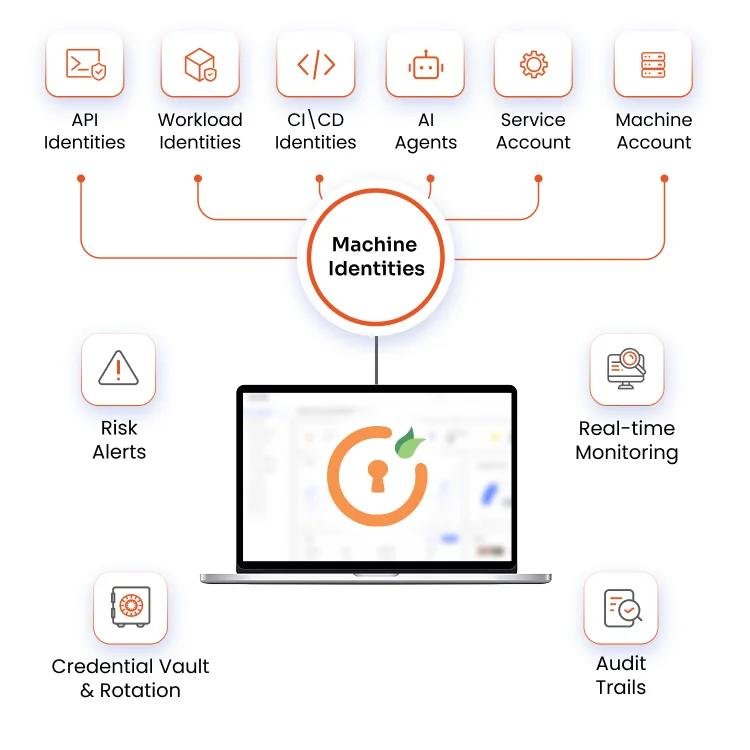
The Rise of Non-Human Identities
Enterprises already manage large numbers of non-human identities.
These include:
- Service accounts
- Applications
- API keys
- Cloud workloads
- Containers
- Devices
- Automation scripts
AI agents add another layer because they can combine machine identity with autonomous decision-making.
A conventional service account may execute a predefined application function.
An AI agent may interpret an objective, select a tool, retrieve information and decide which action to take.
That difference makes machine identity security significantly more important.
Gartner's 2026 research recommends adapting IAM strategies to different AI-agent types rather than applying one uniform approach to every agent. Gartner also identifies identity registration, permissions, lifecycle management and adaptive controls as important parts of managing agent sprawl.
The enterprise identity model is therefore evolving:
Human Identity → Machine Identity → AI Agent Identity
AI Agents Create a New Authorization Problem
Authentication answers:
Who are you?
Authorization answers:
What are you allowed to do?
For AI agents, authorization becomes more complex.
Consider an AI procurement agent.
It may be authorized to read supplier information, compare prices and prepare purchase orders.
But should it be allowed to:
- Approve a major purchase?
- Change a supplier's bank details?
- Delete vendor records?
- Add a new supplier?
- Transfer money?
The answer may depend on the circumstances.
Therefore, an AI agent's authority should not depend only on its identity.
A more appropriate authorization decision may consider:
Identity + User + Purpose + Data + Tool + Action + Context + Risk
This creates the foundation for dynamic authorization for AI agents.
From Role-Based Access to Context-Aware Access
Traditional Role-Based Access Control (RBAC) assigns permissions according to organizational roles.
For example:
Finance Manager → Approve Expenses
Agentic AI requires more context.
An AI agent may be permitted to approve an expense only when:
- The transaction is below a defined threshold.
- The vendor is approved.
- The request comes through an authorized workflow.
- Sensitive information is not being exposed.
- The transaction falls within the agent's assigned purpose.
A higher-risk transaction could require human approval.
This moves enterprises toward Attribute-Based Access Control (ABAC), policy-based authorization and risk-aware access decisions.
The important question becomes:
Not only "Who is this agent?" but "What is this agent trying to do right now?"
Delegated Authority: The Hidden AI Security Problem
One of the most challenging aspects of agentic AI is delegation.
Imagine an employee asking an AI assistant to prepare a financial report.
The primary agent retrieves information and then calls a specialized analytics agent.
Should the second agent automatically receive all the permissions of the first agent?
It should not.
This creates a delegation chain:
Human → Agent A → Agent B → Tool → Enterprise System
Security teams need to understand this chain when investigating an action.
NIST's AI-agent identity work explicitly raises questions about "on behalf of" scenarios, binding agent identity to human identity and proving an agent's authority to perform a particular action.
Without traceable delegation, accountability becomes difficult.
AI Agent Identity and Zero Trust
The principles of Zero Trust security become increasingly important in an autonomous enterprise.
Zero Trust assumes that access should not be automatically trusted simply because an entity is inside the corporate environment.
For AI agents, the principle can be extended:
Continuously verify the agent's identity, authorization, context and behaviour.
An enterprise should evaluate:
- Agent identity
- Authentication strength
- Requested resource
- Data sensitivity
- Requested action
- User context
- Agent behaviour
- Risk level
- Threat intelligence
- Applicable policies
This creates a Zero Trust architecture for AI agents.
The objective is to ensure that if an agent is compromised or manipulated, its access and potential blast radius remain limited.
The AI Agent Identity Attack Surface
AI agents introduce several identity-related attack paths.
Credential Theft
Attackers may target agent credentials, tokens or secrets.
Excessive Permissions
An agent may receive more access than its business function requires.
Identity Spoofing
An attacker may attempt to impersonate a legitimate AI agent.
Token Abuse
Long-lived credentials can provide persistent access.
Agent Hijacking
Prompt injection or other attacks may manipulate an agent into performing unauthorized actions.
Delegation Abuse
Attackers may exploit trust relationships between interconnected agents.
Dormant Agents
Unused agents and credentials can remain active and become forgotten attack paths.
Privilege Escalation
An agent may use legitimate access to reach resources outside its intended purpose.
NIST has highlighted these identity and authorization challenges as central considerations in securing software and AI agents.
The conclusion is straightforward:
Every AI agent is becoming part of the enterprise attack surface.
What an AI Agent Identity Architecture Should Include
A practical AI identity security architecture should include several capabilities.
Agent Registry
Maintain an authoritative inventory of every AI agent, including its owner, purpose, model, environment, data sources and permissions.
Strong Authentication
Use strong machine authentication instead of shared passwords or unmanaged API keys.
Short-Lived Credentials
Where appropriate, use credentials that expire and rotate automatically.
Least Privilege
Give every AI agent only the access required for its defined business function.
Policy-Based Authorization
Evaluate access according to identity, context, requested action and risk.
Delegation Tracking
Record agent-to-agent delegation and the authority behind each action.
Behaviour Monitoring
Detect unusual agent behaviour, unexpected tools and abnormal access patterns.
Continuous Revocation
Security teams should be able to immediately disable an agent or revoke its credentials.
Auditability
Maintain verifiable records of significant agent actions and authorization decisions.
Gartner's AI-agent IAM research similarly points toward centralized governance and policy management across workload identities, secrets, authorization and related IAM capabilities.
When Should an AI Agent Require Human Approval?
Not every AI action requires human intervention.
An agent summarizing a document may operate autonomously.
An agent attempting to delete production data should not.
This creates a risk-based human-in-the-loop model.
Low risk: Autonomous execution.
Medium risk: Policy validation and monitoring.
High risk: Human approval.
Critical risk: Multiple controls or explicit authorization.
For example:
| Risk | Example | Control |
|---|---|---|
| Low | Generate report | Autonomous |
| Medium | Update customer record | Policy validation |
| High | Financial transaction | Human approval |
| Critical | Production infrastructure change | Strong authorization |
The objective is not to put a human into every workflow.
It is to put humans where business impact requires human accountability.
AI Agent Identity Governance
Identity management must be connected to AI governance.
Every organization deploying enterprise AI should establish clear ownership.
A governance framework should define:
- Who can create an AI agent?
- Who approves its permissions?
- Who owns it?
- What information can it access?
- What actions can it perform?
- How long can its credentials remain active?
- How is behaviour monitored?
- How are changes approved?
- What happens when it is compromised?
- When should it be retired?
This transforms AI agents from unmanaged software components into governed enterprise identities.
Common Failure Modes And How To Avoid Them
Organizations deploying AI agents commonly face several risks.
Treating agents like ordinary applications: Autonomous agents require additional context and controls.
Using shared credentials: Shared keys make accountability and revocation difficult.
Giving permanent access: Long-lived credentials increase exposure.
Ignoring ownership: Every production AI agent needs a responsible owner.
Overlooking delegation: Agent-to-agent permissions can unintentionally expand access.
Failing to monitor behaviour: A legitimate identity can still behave abnormally.
Automating high-impact actions: Critical activities require appropriate authorization.
Deloitte's 2026 research found that only 21% of surveyed organizations reported mature governance for agentic AI, while adoption is increasing rapidly.
The lesson is simple:
Autonomy should grow with governance maturity.
What To Prepare Before Deploying AI Agents
Before expanding AI agents across the enterprise, create an AI agent inventory.
For every agent, document:
- Business purpose
- Owner
- Model
- Data sources
- Tools
- APIs
- Permissions
- Authentication mechanism
- Risk classification
- Human approval requirements
- Monitoring requirements
- Retirement criteria
Then establish:
Identity → Least Privilege → Policy → Monitoring → Audit → Revocation
Start with controlled use cases, validate permissions and monitor behaviour before increasing autonomy.
This is particularly important because enterprise adoption is moving rapidly. McKinsey's 2026 survey found that 40% of respondents from organizations with more than $1 billion in annual revenue reported scaling AI agents, compared with 27% the previous year.
Global And Indian Context
AI adoption is accelerating in India as enterprises move from experimentation toward operational deployment.
Deloitte's India 2026 research reports that Indian enterprises are leading global peers in at-scale AI adoption across several business functions, including product development, strategy and operations, marketing and sales, and supply chain.
This creates an important cybersecurity requirement.
As AI agents move into production, AI identity management, machine identity, Zero Trust, least privilege and authorization must become part of enterprise security architecture rather than being added after deployment.
For Indian organizations, the opportunity is substantial—but so is the need to establish accountability for autonomous systems before their permissions and numbers expand.
Timeline, Metrics And Business Value
Organizations should measure the maturity of their AI identity program.
Useful metrics include:
- Number of registered AI agents
- Percentage with identified owners
- Percentage using least privilege
- Excessive permissions
- Credential rotation compliance
- Unauthorized actions
- Authentication failures
- Agent-to-agent delegation events
- High-risk actions requiring approval
- Time required to revoke compromised credentials
- AI identity security incidents
- Dormant agent identities
These metrics provide visibility into the organization's AI identity attack surface.
The principle is the same as traditional cybersecurity:
You cannot secure what you cannot identify.
Conclusion
The enterprise identity model is changing.
For decades, cybersecurity teams primarily asked:
Who are our users?
The autonomous enterprise requires another question:
What are our AI agents allowed to do?
AI agents will increasingly access applications, data, APIs and infrastructure on behalf of employees and organizations.
That makes identity one of the foundations of agentic AI security.
The future will require more than traditional IAM.
It will require AI agent identity, machine identity governance, dynamic authorization, Zero Trust, least privilege, delegation tracking, behavioural monitoring and continuous revocation.
Organizations that build these capabilities early can enable AI autonomy without surrendering control.
Because in the autonomous enterprise, identity is no longer simply about knowing who is accessing the system.
Identity becomes the mechanism that determines what intelligence is allowed to do.
By Dr. Akhilesh Kumar
References
- NIST — Accelerating the Adoption of Software and Artificial Intelligence Agent Identity and Authorization, 2026.
- NIST — Back to the Future: Why Agentic AI Needs a Strong Identity Foundation, 2026.
- Gartner — IAM for AI Agents: A One-Size-Fits-All Strategy Is Guaranteed to Fail, 2026.
- Gartner — Reference Architecture Brief: IAM for AI Agents and Other Workloads, 2026.
- Gartner — Gartner Identifies Six Steps to Manage AI Agent Sprawl, 2026.
- Deloitte — AI Agents Are Only the Beginning: The Path to Agentic Transformation, 2026.
- McKinsey & Company — The State of AI in 2026: On the Road to ROI, 2026.
- Deloitte India — Indian Enterprises Lead Global Peers in At-Scale AI Adoption, 2026.
Comments (0)
No comments yet. Be the first to share your thoughts!
Leave a Comment