
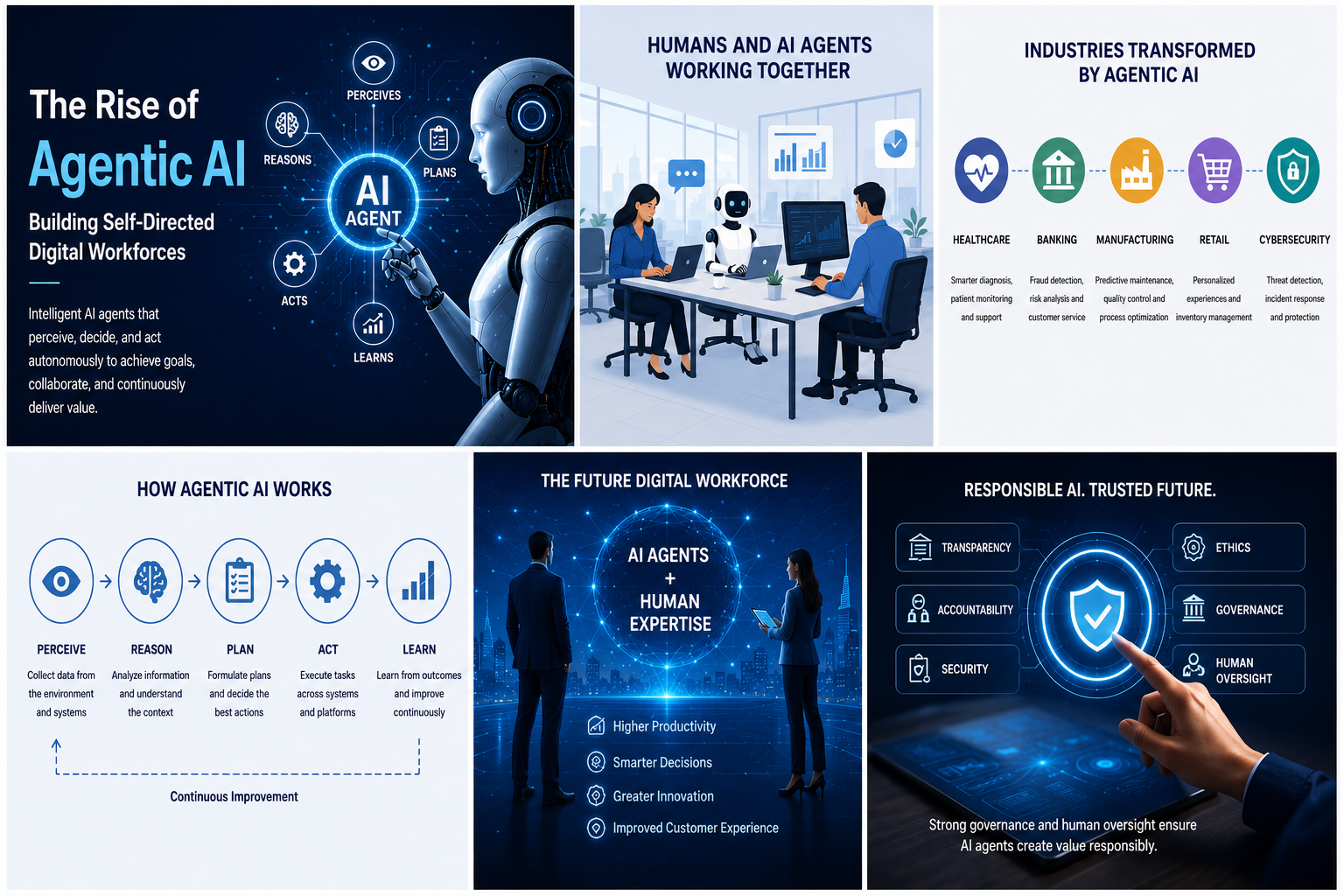
The Rise of Agentic AI: Building Self-Directed Digital Workforces
Artificial Intelligence has progressed far beyond systems that simply answer questions or generate content. A new generation of intelligent software, known as Agentic AI, is redefining how organizations operate by enabling digital systems to perceive, reason, plan, and execute tasks with minimal human intervention. Unlike conventional AI tools that wait for instructions, Agentic AI continuously evaluates situations, makes informed decisions, and adapts its actions to achieve predefined objectives.
This evolution marks the beginning of self-directed digital workforces. Rather than replacing employees, these intelligent agents act as collaborative partners capable of handling repetitive, analytical, and operational responsibilities. They can monitor business processes, coordinate across applications, identify anomalies, generate reports, schedule workflows, and even interact with customers while learning from experience.
The healthcare sector offers a compelling example of Agentic AI in action. Intelligent agents can monitor patient records, prioritise clinical alerts, automate appointment scheduling, optimise resource allocation, and assist medical professionals by summarising patient histories. These capabilities reduce administrative burden, allowing clinicians to devote more time to patient care. Similarly, in banking, autonomous AI agents strengthen fraud detection by continuously monitoring transaction patterns and responding to suspicious activities in real time.
Manufacturing, logistics, retail, and cybersecurity are also embracing Agentic AI. Smart digital agents optimise inventory, predict equipment failures, coordinate supply chains, and detect evolving cyber threats without requiring continuous human oversight. As organizations face increasing operational complexity, these intelligent systems provide faster decision-making, improved efficiency, and greater resilience.
Despite its transformative potential, Agentic AI introduces important governance challenges. Autonomous decision-making requires transparency, accountability, and robust security controls. Organisations must establish clear policies that define the responsibilities, permissions, and monitoring mechanisms for AI agents. Human oversight remains essential, particularly in high-impact domains such as healthcare, finance, and public services, where ethical considerations and regulatory compliance cannot be delegated entirely to machines.
Another critical factor is trust. Employees must understand how AI agents reach decisions and when human intervention is required. Explainable AI, strong cybersecurity practices, and continuous performance monitoring are therefore fundamental to successful deployment. Responsible implementation ensures that Agentic AI becomes a reliable collaborator rather than an unpredictable automation tool.
Looking ahead, digital workforces will likely consist of teams where humans and autonomous AI agents work together seamlessly. Human expertise will remain indispensable for creativity, empathy, strategic thinking, and ethical judgment, while AI agents manage data-intensive and repetitive operations at unprecedented speed and scale. Organizations that invest in responsible AI governance, workforce upskilling, and secure digital infrastructure today will be better positioned to thrive in this new era of intelligent automation.
The rise of Agentic AI represents more than another technological milestone, it signals a fundamental shift in the future of work. Businesses that embrace self-directed digital workforces responsibly will unlock higher productivity, smarter decision-making, and greater innovation while empowering people to focus on solving the complex challenges that truly require human intelligence.
#AgenticAI #ArtificialIntelligence #DigitalWorkforce #EnterpriseAI #AIAgents #FutureOfWork #GenerativeAI #Automation #BusinessTransformation #MachineLearning #CyberSecurity #HealthcareAI #Innovation #DigitalTransformation #TechLeadership
Author: Dr. Akhilesh Kumar
References
- Artificial Intelligence: A Modern Approach.
- Human Compatible.
- Co-Intelligence: Living and Working with AI.
- National Institute of Standards and Technology.
- World Economic Forum.
Comments (0)
No comments yet. Be the first to share your thoughts!
Leave a Comment