
Photonic Computing: The Technology That Could Outperform Silicon
For more than half a century, silicon has been the foundation of modern computing. Every smartphone, laptop, cloud data center, and supercomputer depends on silicon-based semiconductors to process information. Yet as Artificial Intelligence (AI), big data analytics, scientific computing, and advanced simulations demand unprecedented computational power, traditional electronic processors are approaching fundamental physical and energy limitations. This challenge has accelerated global interest in photonic computing, a revolutionary computing paradigm that uses light instead of electricity to process and transmit information.
Photonic computing replaces electrical signals carried by electrons with optical signals carried by photons. Because photons travel at the speed of light and generate significantly less heat than electrical currents, optical processors offer the potential to dramatically improve computing speed, bandwidth, and energy efficiency. Rather than simply enhancing existing semiconductor technologies, photonic computing introduces an entirely new architecture designed to address the demands of the AI era.
Traditional processors perform billions of calculations every second by moving electrons through microscopic transistors. While transistor miniaturisation has driven remarkable advances under Moore's Law, shrinking components further has become increasingly difficult due to power consumption, heat generation, and manufacturing complexity. Modern AI systems amplify these challenges by requiring enormous computational resources to train and deploy foundation models containing billions of parameters. Data movement between processors and memory has become a major performance bottleneck.
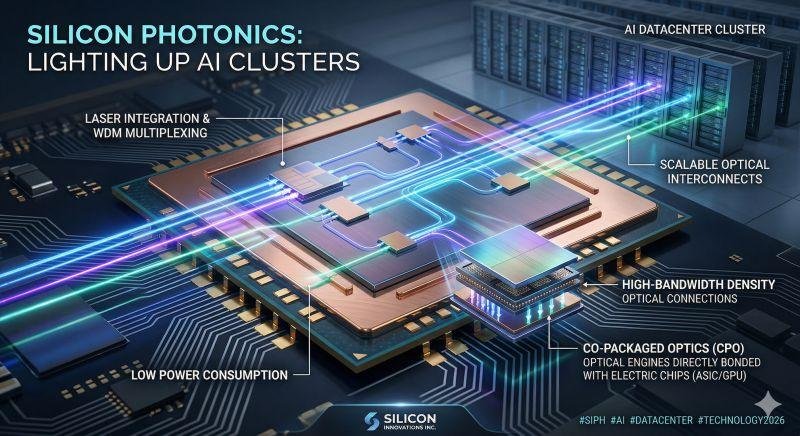
Photonic computing addresses these limitations by enabling information to travel through optical waveguides instead of electrical circuits. Since multiple wavelengths of light can propagate simultaneously within the same optical channel, a technique known as wavelength-division multiplexing (WDM), photonic systems can process vast amounts of information in parallel without significantly increasing energy consumption. This capability makes optical computing particularly attractive for AI inference, deep learning, and high-performance computing applications.
One of the most promising applications of photonic computing is accelerating Artificial Intelligence. Modern neural networks perform enormous numbers of matrix multiplications, which are computationally intensive for conventional processors. Optical processors can execute many of these mathematical operations directly using the physical properties of light, potentially delivering substantially higher computational throughput while consuming far less energy. As AI models continue to grow in size and complexity, photonic accelerators could become essential components of future AI infrastructure.
Data centers also stand to benefit significantly. AI-driven cloud services require massive computing clusters interconnected by high-speed communication networks. Much of the energy consumed within modern data centers is dedicated not to computation itself but to transferring data between processors, memory, and storage. Silicon photonics enables ultra-fast optical communication between computing components, reducing latency while improving energy efficiency. This technology is already being integrated into advanced networking equipment to support next-generation cloud computing environments.
Healthcare represents another exciting application area. AI-powered medical imaging, genomic sequencing, drug discovery, and precision medicine require extraordinary computational performance. Photonic processors could accelerate complex biomedical simulations, analyse medical images more rapidly, and reduce processing times for genomic data, enabling clinicians and researchers to obtain critical insights faster while lowering computational costs.
Scientific research is equally poised for transformation. Climate modeling, astrophysics, molecular dynamics, quantum chemistry, and materials science often require supercomputers capable of processing immense datasets. Photonic computing offers the possibility of significantly increasing simulation speed while reducing power requirements, enabling researchers to tackle problems that remain computationally prohibitive using conventional architectures.
Technology companies such as IBM, Intel, NVIDIA, Lightmatter, Lightelligence, and Ayar Labs are actively advancing silicon photonics, optical interconnects, photonic integrated circuits, and AI-focused optical processors. Their research reflects growing confidence that light-based technologies will become increasingly important in future computing ecosystems.
Despite its promise, photonic computing is not expected to replace silicon processors entirely in the near future. Instead, hybrid computing architectures are emerging in which electronic processors manage general-purpose computing while photonic accelerators perform specialised AI, networking, and data-intensive workloads. This complementary approach allows organizations to benefit from the strengths of both technologies while minimising implementation complexity.
Several engineering challenges remain before photonic computing achieves widespread adoption. Manufacturing photonic integrated circuits at commercial scale requires highly specialised fabrication processes. Integrating optical and electronic components onto a single chip remains technically complex, while software frameworks must evolve to support optical computing architectures efficiently. Cost, standardisation, and ecosystem maturity will also influence the pace of adoption.
Artificial Intelligence itself is helping accelerate photonic innovation. AI algorithms optimise optical chip designs, improve fabrication processes, detect manufacturing defects, and model complex optical behaviours more efficiently than traditional simulation methods. This creates a positive feedback cycle in which AI enables better photonic hardware, which in turn provides more efficient computing for AI applications.
Looking toward the future, photonic computing will likely become an essential pillar of next-generation computing alongside neuromorphic processors, quantum computing, heterogeneous architectures, and advanced semiconductor technologies. Rather than representing a replacement for silicon, photonics expands the computing landscape by introducing highly specialised capabilities that address the growing demands of AI and data-intensive applications.
As sustainability becomes a global priority, energy-efficient computing architectures will play an increasingly important role. Data centers already consume significant amounts of electricity worldwide, and AI adoption continues to increase computational demand. Photonic processors offer the potential to deliver greater performance while reducing energy consumption, contributing to more environmentally sustainable digital infrastructure.
In conclusion, photonic computing represents one of the most promising technological frontiers beyond traditional semiconductor scaling. By harnessing the speed and efficiency of light, optical processors have the potential to overcome many of the limitations facing electronic computing while enabling breakthroughs in artificial intelligence, healthcare, scientific research, telecommunications, and cloud infrastructure. Although widespread deployment will require continued engineering innovation, photonic computing is steadily moving from research laboratories toward practical applications. The future of computing may not be powered solely by silicon, it may increasingly be illuminated by light.
#PhotonicComputing #OpticalComputing #ArtificialIntelligence
#SiliconPhotonics #Semiconductors #HighPerformanceComputing
#AIInfrastructure #NextGenerationComputing #Photonics #ChipInnovation
#FutureTechnology #DataCenters #ComputerArchitecture #DeepLearning
#DigitalTransformation #TechnologyInnovation #DrAkhileshKumar
Author: Dr. Akhilesh Kumar
References
- IBM. Research on Silicon Photonics and High-Performance Computing.
- Intel. Silicon Photonics Technology and Optical Interconnect Research.
- NVIDIA. AI Infrastructure and Advanced Data Center Computing.
- Lightmatter. Photonic Computing for Artificial Intelligence.
- Lightelligence. Optical AI Accelerators and Photonic Processors.
- Ayar Labs. Optical I/O and Chip-to-Chip Photonic Connectivity.
- Institute of Electrical and Electronics Engineers. Publications on Photonic Integrated Circuits and Optical Computing.
- Association for Computing Machinery. Research on Emerging Computer Architectures and AI Computing.
- Optica. Research on Optical Computing, Photonics, and Integrated Photonic Systems.
Comments (0)
No comments yet. Be the first to share your thoughts!
Leave a Comment