
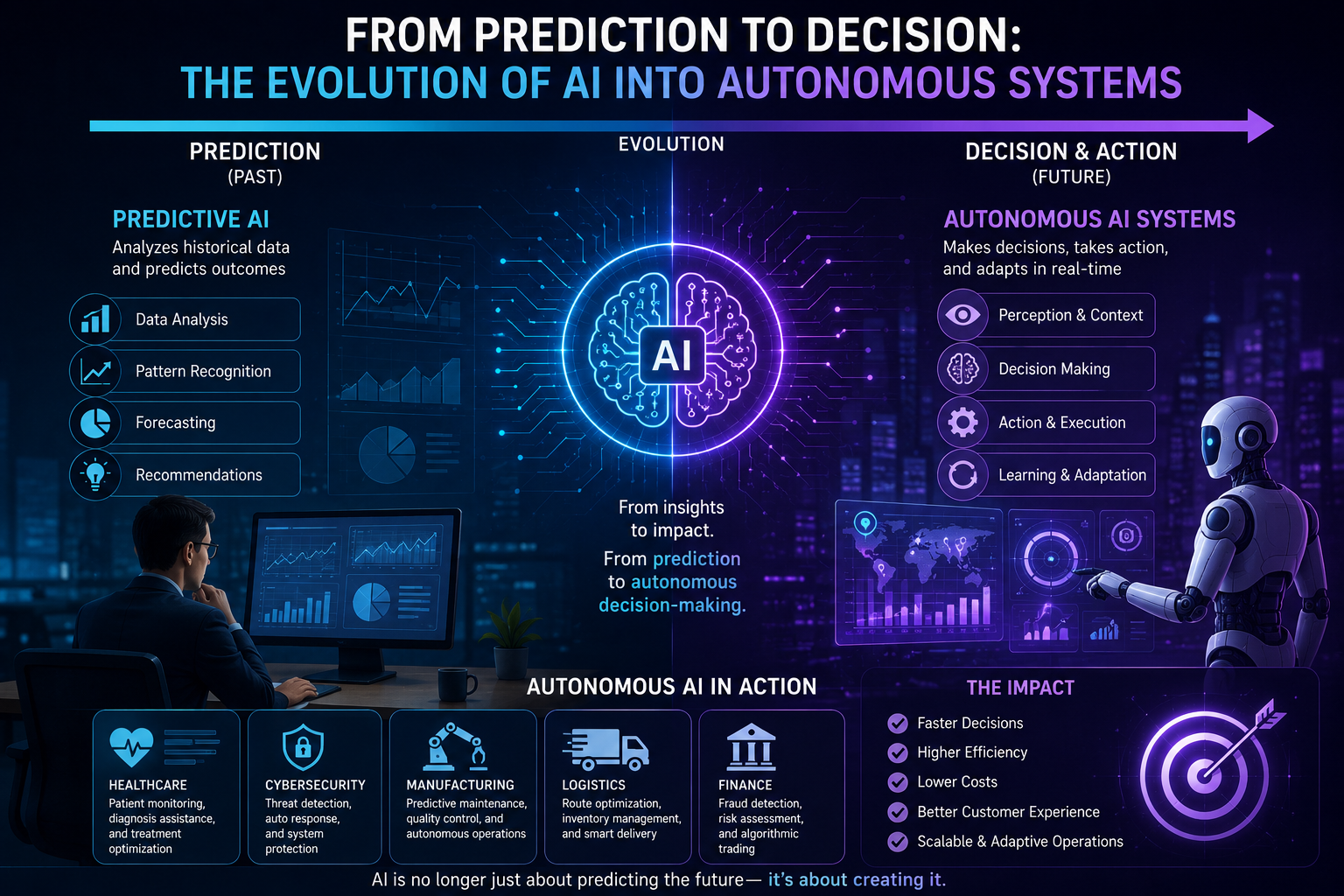
From Prediction to Decision: The Evolution of AI into Autonomous Systems
Artificial Intelligence (AI) has undergone a remarkable transformation over the past decade. Initially developed to identify patterns and make predictions from historical data, AI is now entering a new era where it can independently analyse situations, make decisions, and execute actions with minimal human intervention. This shift from predictive intelligence to autonomous decision-making is reshaping industries and redefining the relationship between humans and intelligent machines.
Traditional AI systems excelled at forecasting outcomes. They recommended products on e-commerce platforms, detected fraudulent financial transactions, predicted equipment failures in manufacturing, and assisted doctors by identifying abnormalities in medical images. While these systems improved efficiency, they still relied heavily on human supervision to interpret recommendations and initiate actions.
Today, advances in large language models, reinforcement learning, multimodal AI, and autonomous agents have expanded AI's capabilities far beyond prediction. Modern AI systems can gather information from multiple sources, evaluate different courses of action, prioritise objectives, and execute complex workflows independently. Rather than functioning as passive analytical tools, these systems increasingly act as intelligent collaborators capable of solving operational challenges in real time.
The healthcare industry demonstrates this transformation clearly. Autonomous AI systems can monitor patient conditions continuously, prioritise emergency cases, coordinate hospital resources, and generate clinical summaries for physicians. In cybersecurity, intelligent agents identify suspicious activities, isolate compromised systems, launch automated incident responses, and strengthen organizational resilience against evolving cyber threats. Similarly, in logistics and manufacturing, autonomous AI optimises delivery routes, manages warehouse inventories, predicts maintenance requirements, and adjusts production schedules based on changing demand.
This progression offers significant advantages. Organizations benefit from faster decision-making, reduced operational costs, improved productivity, enhanced customer experiences, and greater scalability. By automating repetitive and data-intensive activities, AI allows professionals to dedicate more attention to strategic planning, innovation, and human-centred problem-solving. Instead of replacing skilled employees, autonomous AI augments human expertise by handling routine operations with speed and consistency.
However, greater autonomy also introduces greater responsibility. AI systems making independent decisions must operate within clearly defined governance frameworks that ensure fairness, accountability, transparency, and security. Organizations must establish robust policies governing how autonomous systems access data, interact with users, and escalate decisions requiring human oversight. Explainable AI techniques, continuous monitoring, cybersecurity safeguards, and regulatory compliance are essential to maintaining trust in autonomous technologies.
Ethical considerations are equally important. Decisions affecting healthcare, finance, public services, and critical infrastructure should always include appropriate human supervision. AI can process information faster than humans, but it cannot fully replicate ethical reasoning, empathy, or contextual judgment. Successful organizations will therefore adopt a "human-in-the-loop" approach, combining machine intelligence with human expertise to achieve responsible and reliable outcomes.
Looking ahead, autonomous AI will become an integral part of enterprise operations. Digital workers will collaborate with human teams, automate cross-functional workflows, and continuously adapt to changing business environments. Companies investing in responsible AI governance, workforce upskilling, and secure digital infrastructure today will be better prepared for this transformation.
The evolution of AI from prediction to decision is not simply a technological milestone—it represents a fundamental shift in how work is performed. Organizations that embrace autonomous systems responsibly will unlock unprecedented opportunities for innovation, resilience, and sustainable growth while ensuring that human intelligence remains at the center of strategic decision-making.
#ArtificialIntelligence #AutonomousAI #PredictiveAI #AIAgents #EnterpriseAI #FutureOfWork #DigitalTransformation #MachineLearning #ResponsibleAI #AIInnovation #CyberSecurity #HealthcareAI #Automation #TechLeadership #Innovation
Author: Dr. Akhilesh Kumar
References
- Artificial Intelligence: A Modern Approach.
- Human Compatible.
- Co-Intelligence: Living and Working with AI.
- National Institute of Standards and Technology.
- World Economic Forum.
- OECD.
Comments (0)
No comments yet. Be the first to share your thoughts!
Leave a Comment